Missed-Call Text-Back vs AI Answering (2026): Which One Actually Recovers the Lead?
A text-back tool sends “Sorry we missed you” for $19 a month. AI answering picks up the call. Here is what each one actually recovers, what it costs at 50, 200 and 1,000 calls a month, and the consent rules in the US, UK and India.
The short answer
- $19per user per month for text-back on Quo, October 2026
- $0.0083per US SMS segment on Twilio, before carrier fees
- $300per month for 30 live-answered calls at Smith.ai
- $0.07per minute for AI answering on Adya (₹6 in India)
Missed-call text-back gives callers a route to follow up. The moment a call rings out, software texts the caller — “Sorry we missed you, how can we help?” — and some of them reply instead of calling the next business. It costs $19 to $97 a month on published plans, and it recovers the share of callers who were willing to wait. It does not answer the question they rang with.
AI answering does the other thing: it picks up. The caller gets their price, their booking or a transfer to a person, on the call, and the follow-up text becomes a confirmation rather than an apology. The value depends on what those calls mean to your business: additional bookings, faster answers and less time spent chasing callbacks. A small number of valuable enquiries can justify better coverage; the cost table below helps you model your usage.
How missed-call text-back works (and its three failure points)
The mechanism is simple. Your business number sits behind a phone platform or a call-tracking tool. When an inbound call ends without being answered — ring-out, voicemail, busy — the platform fires an automation that sends a pre-written SMS to the caller’s number. Quo describes its version as auto-replies that “respond to texts, missed calls, or voicemails with pre-defined messages”; CallRail bundles 25 texts into its $50 Lead Tracking plan; GoHighLevel-based agency tools wrap the same trigger inside a $97-a-month CRM.
It works, up to a point. Some callers reply, and a reply you answer at your own pace beats a lead you never knew about. The problems are structural, not technical.
1. The text cannot reach everyone who called
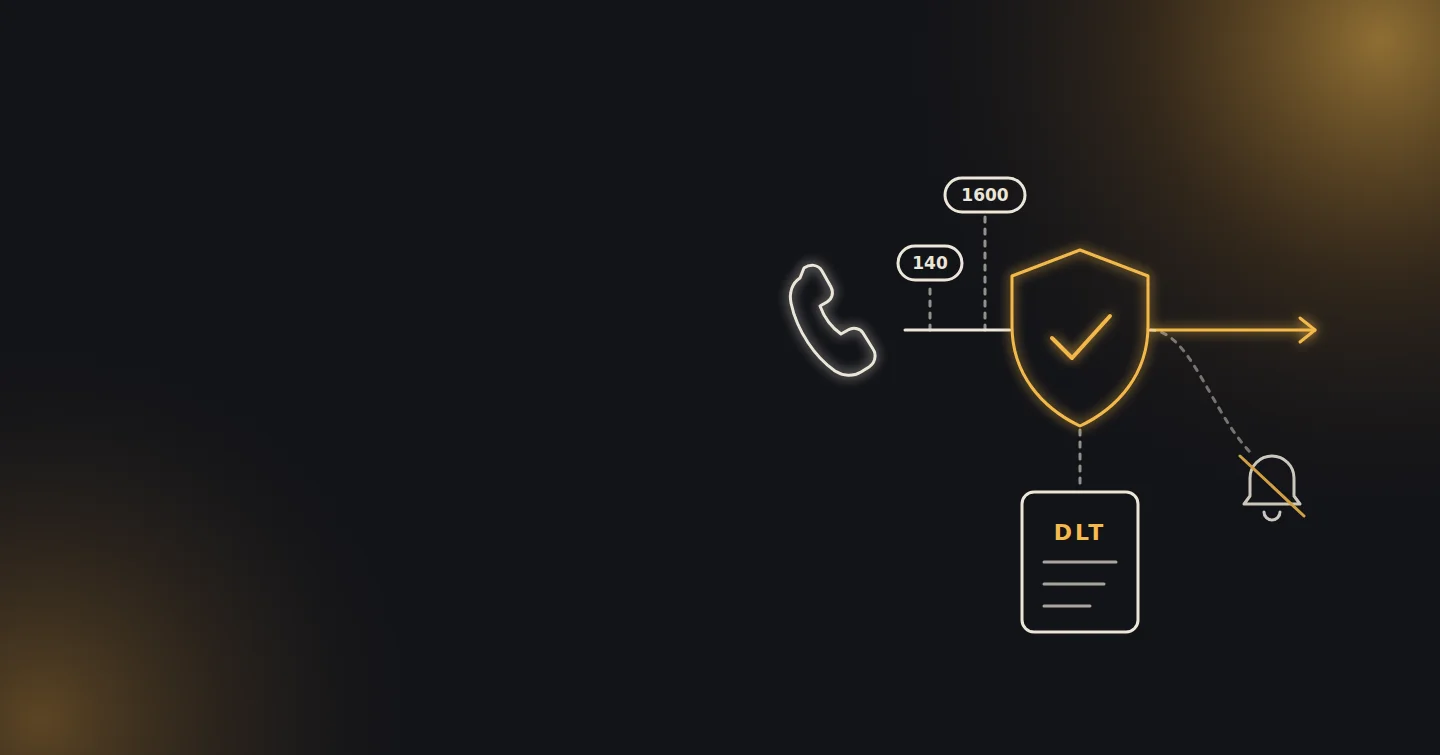
Landlines cannot receive SMS, and a withheld number cannot be texted. In the US, texting from a business number first needs brand and campaign registration with The Campaign Registry — Quo charges a $19.50 one-time fee and $1.50 to $3 a month for it. In India, a commercial SMS needs a DLT-registered sender and content template before it is delivered at all.
2. The text does not answer the question
The caller rang because they wanted something now: a price, an appointment, confirmation that you cover their postcode. “We’ll get back to you” gives them none of it. A customer who was comparing two plumbers now has one who did not pick up and one who did. The text recovers the patient callers and loses the urgent ones, and the urgent ones are usually the jobs.
3. Someone still has to read the replies
Every reply lands in an inbox, and a reply nobody answers for forty minutes is a second missed contact. The tool moved the work from the phone to the thread; it did not remove it. After hours, the text invites a conversation that cannot start until morning.
SMS vs WhatsApp for the text-back: deliverability, cost, consent
Should the text-back go on WhatsApp instead? For a caller you already know, often yes. For an unknown caller, no — and the reason is a rule, not a preference.
| SMS | ||
|---|---|---|
| Reaches an unknown caller | Any mobile number | Only numbers registered on WhatsApp |
| Needs prior opt-in | One conversational reply: generally no (US CTIA); marketing: yes | Yes — Meta requires opt-in before any business-initiated message |
| Fails when | Landline, withheld number, unregistered sender | Number not on WhatsApp (error 131026); no opt-in |
| Cost to send | $0.0083 per US segment on Twilio, plus carrier fees; bundled free on Quo plans | Meta's per-market template rate, e.g. ₹0.1150 utility in India |
| Free reply window | None — every segment is billed | 24 hours after the customer's last message; a template is required after that (error 131047) |
| Rich content | 160 characters per segment, links as text | Buttons, images, booking links, read receipts |
Meta’s rule is explicit: “Businesses are required to obtain opt-in before messaging people on WhatsApp.” The opt-in must name your business and say what the person is agreeing to, and Meta lists SMS, a website, an IVR flow and paper as valid ways to collect it. A missed call is not on that list. If the caller has never opted in, a WhatsApp text-back is a policy breach even when it is technically deliverable; if their number is not on WhatsApp, it is simply not delivered.
So the practical design is two-tier. Unknown caller: one SMS, informational, with an opt-out line. Known customer who has opted in: WhatsApp, because it carries a booking button and a read receipt, and because a reply from them opens a 24-hour window in which your messages are free-form. We covered Meta’s per-message rates in WhatsApp Business API pricing.
What AI answering does instead: answer, book, transfer
An AI answering agent can receive calls through your configured number or forwarding route and answer calls throughout your configured coverage hours, including after hours and while you are on another call. It speaks first, listens, and answers from a knowledge base you gave it: opening hours, service area, prices, what to bring. Three things separate it from a text-back, and from the voicemail it replaces.
It answers. The caller who wanted a price gets the price. The caller who wanted to know if you cover their area gets a yes or a no. The conversation that a text-back defers to tomorrow happens now, in the caller’s language — on Adya, English plus ten Indian languages, detected automatically.
It books. With a booking calendar attached, the agent checks live availability, offers up to three real slots and books the one the caller picks, writing it to Google Calendar. The missed call that would have become a text thread becomes an appointment with a confirmation already sent. The mechanics are on our appointments page.
It transfers. When the caller needs a person and one is available, the agent asks, then hands the live call to your team with an AI-written summary, so nobody repeats themselves. Outside live hours it takes the details and creates a ticket with a reference number. That is the human handoff flow; how a call is routed and recorded is on how voice works.
The text does not disappear in this model; it changes job. After the call, Adya sends a WhatsApp follow-up to callers who have opted in — booking details, quote, address — the message a customer actually keeps. The apology text was only ever a substitute for the call.
Cost comparison at 50, 200 and 1,000 calls a month
Three ways to handle the same calls: text them back, pay a live answering service, or put an AI agent on the line. The figures below are each vendor’s published price on October 10, 2026, applied to one assumption — an average call of three minutes — with no overage you can avoid. Text-back prices assume every call in the column was missed, because a text-back only fires on a missed call.
| Route | 50 calls | 200 calls | 1,000 calls | What the caller gets |
|---|---|---|---|---|
| Text-back on Quo (1 user) | $19 | $19 | $19 | An SMS; a reply when you are free |
| Text-back on CallRail | $50.75 | $55.25 | $79.25 | An SMS; a reply when you are free |
| Live answering, Smith.ai | $530 | $1,965 | $8,050 | A person, 24/7, who takes a message or books |
| Adya (Amomic) AI answering | $99 (₹7,999) | $106 (₹8,599) | $274 (₹22,999) | An answer, a booking or a transfer, on the call |
Compare the outcome alongside the price. Text-back acknowledges a missed enquiry and starts a message thread. Live answering brings a person into the conversation. Adya can answer routine questions, book a slot and hand off to your team. On the Growth example, 1,000 three-minute calls use 3,000 minutes: $99 plus 2,500 × $0.07 is $274, or about $0.27 per answered call, before tax and any separate messaging usage.
For 50 three-minute calls, Starter is $39 plus a $3.99 Indian number plus 150 × $0.07: $53.49 (₹4,298 in India), before tax. Growth adds 5,000 conversations, more agents and team seats, outbound campaigns and priority support alongside its included minutes. Choose the plan for your whole customer operation.
Use booking value, not a call-count cutoff
Divide the additional monthly cost by the contribution from one additional booking, after its delivery and handling costs. For illustration, ₹5,000 of additional cost and ₹2,500 contribution per recovered booking need two additional bookings to cover that cost. This is a planning scenario, not a promised result. Measure an overflow pilot to find your own numbers.
After-hours: what to say, what to automate
Most missed calls are not missed at 11 a.m. They are missed at lunch, after six and on Sunday, which is exactly when a text-back invites a conversation that will not start until morning. Whichever route you pick, the after-hours wording carries the weight.
If you are texting back
Say when you will reply, not that you will. “Sorry we missed your call. We’re open from 9 a.m. and will ring you then — reply with your postcode and the job to save time. Reply STOP to opt out.” That is informational, sets an expectation and collects what you need for the callback. Leave out the discount code: it changes the consent category in every country above.
If AI is answering
Set a per-number opening line for after-hours — Adya lets each number carry its own greeting, language and recording setting — and decide what the agent may do alone. Booking into tomorrow’s free slots: yes. Quoting a fixed menu of prices: yes. Promising an emergency visit tonight: only if someone is on call, and the handoff settings say so. The agent then takes the details, books or tickets, and the caller hears a confirmation instead of a beep.
Automate the follow-up either way: time, address and what to bring, in writing, on your configured channel. Use WhatsApp with opt-in; a separate SMS provider can cover callers who prefer SMS. Do not automate a promise you cannot keep. “We’ll call you back in five minutes” at midnight is worse than voicemail.
Decision table: text-back, AI answering, or both
Start with the caller’s intent, the value of a booking and your team’s response capacity. Use your call log to size the pilot.
| Your situation | Text-back | AI answering | Both |
|---|---|---|---|
| Under 50 misses a month, callers can wait, you reply to texts yourself | Can suit a staffed reply inbox | Adds immediate answers and booking without waiting for a callback | No |
| Under 50 misses, time-sensitive booking enquiries | Acknowledges the enquiry; needs a prompt human response | Yes — Starter route from $53.49 (₹4,298) | Only if you want an SMS to callers who are not on WhatsApp |
| 50–200 misses a month, one or two staff | Replies pile up; someone's day becomes the inbox | Yes — $99–$106 (₹7,999–₹8,599) on Growth | Yes: AI answers, text confirms |
| 200–1,000 calls a month, bookings matter | Needs staff capacity to handle the resulting reply threads | Yes — $274 (₹22,999) at 1,000 calls, $0.27 per call | Yes: AI answers, WhatsApp follow-up to opted-in callers |
| Callers need a human for most requests (legal intake, complex sales) | No | As the front door, with handoff during live hours | AI handles the first enquiry; your team takes over with context |
| Mostly existing customers, mostly on WhatsApp, India | SMS only — no WhatsApp without opt-in | Yes, with WhatsApp follow-up after the call | Yes |
“Both” is not a hedge; it is the usual end state. The AI answers the call, the customer gets a written confirmation on the channel they have consented to, and the text-back trigger stays in place for the rare call that connects and then fails.
Set up a focused pilot
Text-back route
1. Port or forward your business number to a platform with missed-call auto-replies; Quo lists them on every plan.
2. Register the sender: 10DLC via The Campaign Registry in the US ($19.50 on Quo), a DLT header and content template in India, nothing extra in the UK beyond PECR compliance.
3. Write one informational text per state — business hours, after hours, weekend — with a STOP line and no offer.
4. Decide who owns the reply inbox and the maximum reply time, and put it on their calendar.
5. Count replies against misses after thirty days. Review replies, completed bookings and time to respond before expanding the workflow.
AI answering route
1. Create the agent and paste in what you tell callers every day: hours, area, prices, the five questions you answer most.
2. Confirm an available number and your existing number’s forwarding arrangements with our team, then deploy the agent to it with its own opening line.
3. Attach a booking calendar and connect Google Calendar so busy slots are blocked.
4. Set live hours and transfer sensitivity in human handoff, and choose who can go available.
5. Make three test calls: a booking, a price question, a request for a person. Read the transcripts, then go live.
Frequently asked questions
No. WhatsApp can only deliver to a number registered on WhatsApp, and Meta requires the business to hold that person's opt-in before sending a business-initiated message. A send to a number that is not on WhatsApp fails with Meta's error 131026 (message undeliverable), and a message sent more than 24 hours after the customer's last reply must be an approved template (error 131047 otherwise). For a missed call from an unknown number, the reliable fallback is SMS; use WhatsApp for callers who have already opted in.
Text-back can work when callers are happy to wait and someone owns the reply inbox. AI answering adds immediate answers, booking and handoff, which can matter even at a low call volume. Compare the additional monthly cost with the contribution from bookings you could recover and the staff time saved. Run an overflow pilot to measure the result for your business.
It replaces the trigger, not the channel. AI answering handles calls that would otherwise reach voicemail, while a text-back can remain as a fallback. The text still has a job after the call: a confirmation, a booking link or a quote summary, sent on SMS or on WhatsApp where the customer has opted in. Adya does both on one plan: it answers the call and sends a WhatsApp follow-up to callers who have opted in, with Starter at $39 a month (₹2,999 in India), plus number rental, voice usage and applicable Meta messaging charges.
Usually, for one informational reply with no offer in it, but the rule depends on the country. In the US, 47 CFR 64.1200 requires prior express consent for autodialed texts to mobiles and prior express written consent for marketing texts; the CTIA's May 2023 Messaging Principles treat a consumer-initiated exchange answered with one relevant message as conversational, needing no further permission. In the UK, PECR regulation 22 requires consent or the soft opt-in for marketing texts. In India, commercial SMS must go through a DLT-registered sender and content template under TRAI's TCCCPR. Add a coupon to the text and it becomes marketing in all three.
Published prices checked October 10, 2026: Quo (formerly OpenPhone) from $19 per user per month with unlimited US and Canada texting on a fair-use policy, plus a one-time $19.50 carrier registration fee; CallRail Lead Tracking from $50 a month with 25 texts included and $0.03 per extra text; GoHighLevel from $97 a month plus usage. Podium, Weave and Textline do not publish prices. Sending the text yourself through Twilio costs $0.0083 per US SMS segment plus carrier fees, before the software that triggers it.
Sources
- 1.Quo (formerly OpenPhone) — pricing: Starter $19/user, auto-replies to missed calls, 10DLC fees
- 2.CallRail — pricing: Lead Tracking $50/month, 25 texts included, $0.03 per additional text
- 3.GoHighLevel — pricing: Starter $97/month plus usage
- 4.Twilio — SMS pricing, United States: $0.0083 per segment and carrier fees
- 5.Smith.ai — virtual receptionist pricing: $300/30 calls, $810/90, $2,100/300, per-call overage
- 6.47 CFR § 64.1200 — Delivery restrictions (TCPA rules), Cornell LII
- 7.CTIA — Messaging Principles and Best Practices, May 2023 (consent categories)
- 8.ICO — Guide to PECR: electronic mail marketing (regulation 22, soft opt-in, texts)
- 9.Meta for Developers — WhatsApp Business Platform: getting opt-in
- 10.Meta for Developers — WhatsApp Cloud API error codes (131026, 131047)
- 11.TRAI — Telecom Commercial Communications Customer Preference (Second Amendment) Regulations, 2025, notified February 12, 2025
- 12.Adya pricing — our full price list